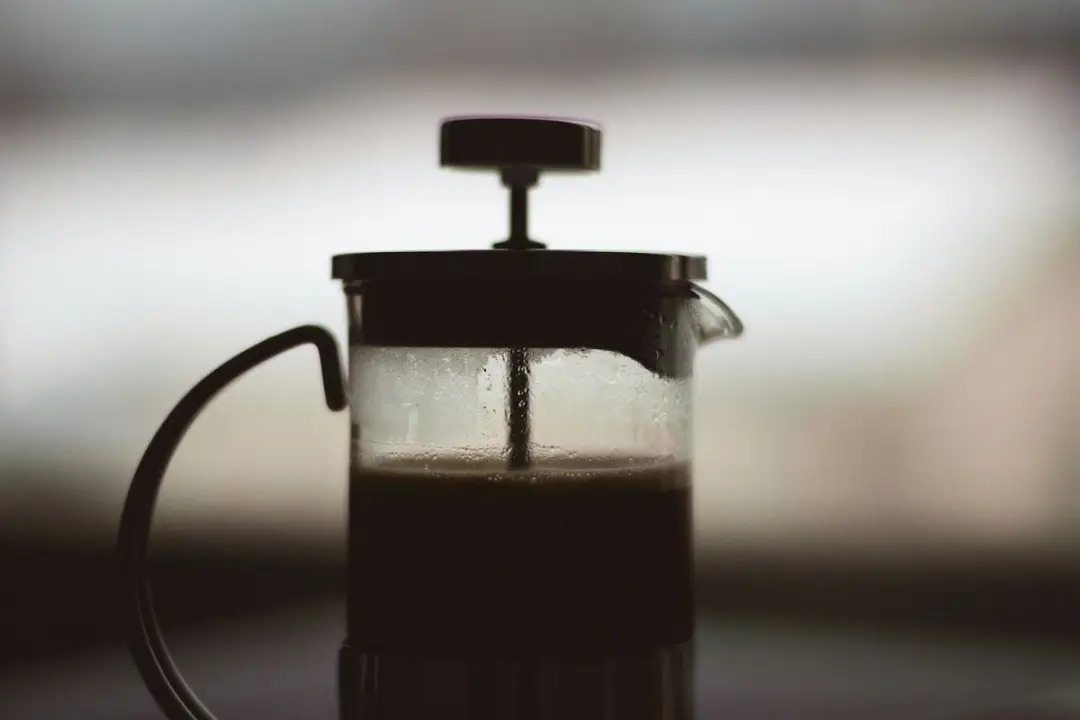
French press coffee is one of the most forgiving and rewarding brewing methods you can learn at home. Coarse-ground beans steep in hot water for four minutes, you press the plunger down, you pour. No paper filters, no machines, no electricity. The cup that comes out is rich, full-bodied, and tastes like the beans you put in.
This guide covers how to use a French press the right way, the exact ratio, grind size, water temperature, and steep time that produce a clean, flavourful cup. We’ll also cover the common mistakes that lead to sludge, bitterness, or weak coffee, and three French presses we’d actually recommend at different price points. If you are still choosing a method, our overview of how to make coffee compares nine of them.
The short answer: French press coffee in 6 steps
Before we dive into the detail, here is the entire method:
- Boil water and let it sit for 30 seconds to drop to ~200°F.
- Add coarse grounds to the French press at a 1:15 ratio (e.g. 30g coffee for 450g water).
- Pour in the water, wetting all grounds. Wait 30 seconds for the bloom.
- Stir gently, place the lid on with plunger up, and steep for 4 minutes.
- Press the plunger down slowly over 15–20 seconds.
- Decant immediately into a cup or carafe so the coffee stops extracting.
That is the whole process. The detail that follows is about why each step matters and how to fix the cup if it does not taste right.
What you need to make French press coffee
French press is one of the cheapest entry points into quality home coffee. You need three things: a press, a kettle, and freshly ground coffee. Everything else is optional.
The essentials
- A French press (any size, most home brewers use 32 or 34 oz)
- A kettle (electric or stovetop, a gooseneck is nice but not required)
- Freshly ground coarse coffee
- A digital scale (helps with consistency, under $15 on Amazon)
- Filtered water
Three French presses worth the money
The French press market is full of $15 glass models that crack within a year. If you want something that lasts and brews a noticeably better cup, three options stand out at different price points:
The Bodum Chambord 34 oz is the classic. It is the press that everyone has owned at some point, borosilicate glass carafe, polished stainless steel frame, made in Portugal. Around $40, brews 8 cups, dishwasher safe. If you want one French press for life and you want it to look like a French press, this is it.
The ESPRO P3 solves the single biggest complaint about French press coffee, sediment in the cup. Its patented double micro-filter is fine enough that you get an almost paper-filter-clean cup, but you keep the rich body that French press is known for. Wirecutter’s pick for best French press, and our recommendation if sludge has put you off the method before.
The Frieling Double-Walled Stainless Steel 36 oz is the unbreakable option. Vacuum-insulated stainless steel, no glass to shatter, no chrome to flake. Keeps coffee hot for over an hour, which is ideal if you brew once and sip slowly. The premium pick at around $120.
For most people the Bodum Chambord is the right buy, it looks beautiful, brews great coffee, and costs less than dinner out. Upgrade to the ESPRO if sediment bothers you, or to the Frieling if you have ever broken a glass press and do not want to do it again.
Choosing your beans for French press
French press is one of the few brewing methods that flatters almost any roast. The metal mesh filter does not absorb the coffee’s natural oils, those oils end up in the cup, giving the coffee a heavier, richer body than paper-filtered methods.
That said, certain beans shine more than others. Medium and medium-dark roasts with chocolate, caramel, or nutty notes (Brazilian, Colombian, Sumatran) are the easiest to get right. Light roasts work too, especially African beans with bright fruit notes, they just require more attention to the grind and steep time. Very dark roasts can taste over-extracted on French press if you push the steep past four minutes.
For our specific picks, see the best coffee for French press guide. Freshness matters more than for cold brew, beans within 2–4 weeks of their roast date taste significantly better than older bags. Check our piece on how to tell if coffee beans are fresh if you are unsure.
The French press coffee ratio
Use a 1:15 coffee-to-water ratio for French press. That is one part coffee to fifteen parts water by weight. The Specialty Coffee Association’s Golden Cup standard, slightly adapted for the longer steep that immersion brewing requires.
| French press size | Water (g) | Coffee (g) | Coffee (tablespoons) |
|---|---|---|---|
| 3-cup (12 oz / 350 ml) | 350 | 23 | ~3 tbsp |
| 4-cup (17 oz / 500 ml) | 500 | 33 | ~4 tbsp |
| 8-cup (34 oz / 1000 ml) | 1000 | 67 | ~8 tbsp |
| 12-cup (51 oz / 1500 ml) | 1500 | 100 | ~12 tbsp |
“Cup” on French press sizing is a 4-oz measure, not a US 8-oz cup. So a “12-cup” French press makes 12 × 4 oz = 48 oz of coffee, not 12 mugs. Confusing but standard across all brands.
If you want a stronger brew, go to 1:14. If you want lighter, go to 1:16. A digital scale removes the guesswork, tablespoons vary wildly depending on grind size and how packed the spoon is. For more on dialling in beans by weight, see our guide to how many coffee beans per cup.
French press grind size: coarse, not too coarse
Grind your beans to a coarse texture, about the size of coarse sea salt or breadcrumbs. Finer than this and you will get sludge plus bitter, over-extracted coffee. Coarser and your cup will taste weak and watery.
| Brew method | Grind size | Texture reference |
|---|---|---|
| Espresso | Very fine | Powdered sugar |
| Drip / pour-over | Medium | Table salt |
| French press | Coarse | Coarse sea salt / breadcrumbs |
| Cold brew | Coarse-extra coarse | Cracked peppercorns |
The reason French press needs a coarse grind: the mesh filter does not catch fine particles. Anything smaller than the mesh openings will end up in your cup. Coarse grounds also slow down extraction over the 4-minute steep, which is what we want for a balanced, not over-extracted cup.
Burr grinders produce the most even coarse grind. Blade grinders make some powder and some chunks at the same setting, which means your cup will be over-extracted (from the powder) and under-extracted (from the chunks) at the same time. If you can only afford one upgrade, a $100 burr grinder will improve your French press cup more than a $400 French press would. Check the type of grinder you are using, it matters more than most people realise.
Water temperature: just off the boil
Use water at around 200°F (93°C). That is just-boiled water that has sat for 30 seconds. Boiling water (212°F) is slightly too hot and can scorch the grounds, pulling out bitter compounds. Water under 195°F will under-extract and the cup will taste sour.
If you do not have a temperature-controlled kettle, the simple rule is: boil, then count 30 seconds before pouring. That drops the temperature by about 5°F and lands you in the right zone. A gooseneck kettle helps with even pouring but is not required for French press the way it is for pour-over.
Cold filtered water is better than tap or bottled, coffee is 98% water, so water quality matters. If your tap water tastes good cold, it will make good coffee. If it tastes like chlorine or minerals, filter it first.
Step-by-step: how to make French press coffee
This is the full method using a standard 34 oz French press. Adjust the quantities for your size, the ratio and technique stay the same.
You will need
- ~60g coarsely ground coffee (~8 tablespoons)
- ~900g (900ml) filtered water
- Kettle
- Digital scale (recommended)
- Timer (your phone is fine)
- A long spoon for stirring
The method
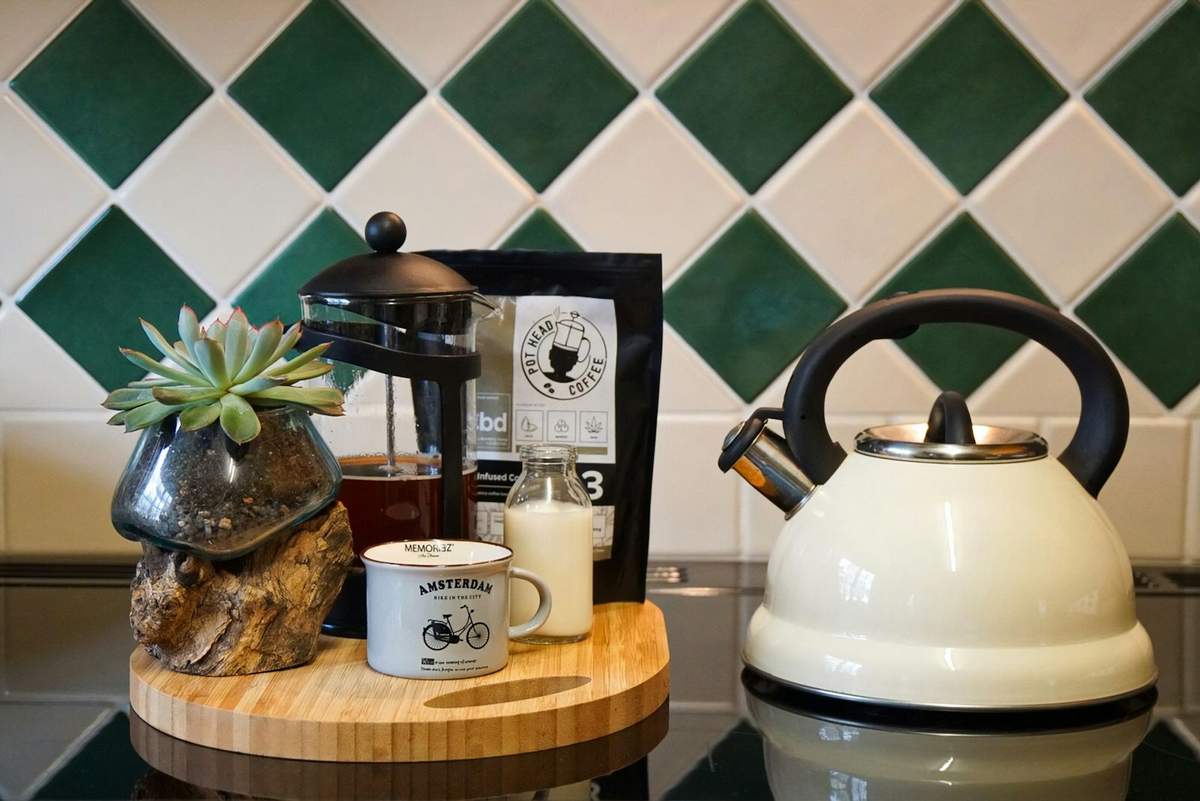
- Boil water and pre-warm the French press. Pour a little of the just-boiled water into the empty press and swirl it around. This keeps the coffee hot during the steep. Tip it out.
- Add coffee. Weigh out 60g of beans and grind them coarse, or use ~8 tablespoons of pre-ground coarse coffee. Add to the press.
- Start your timer and pour. Pour ~900g of just-off-the-boil water in steadily, making sure all grounds get wet. Aim to finish pouring within 15 seconds.
- Bloom. Watch the grounds swell and bubble, that is CO2 escaping. This bloom phase takes about 30 seconds.
- Stir gently at 1 minute. Use a long spoon to break the crust on top and submerge any floating grounds. This is the most important step most people skip.
- Place the lid on with plunger pulled all the way up. The lid keeps the heat in but the mesh is not yet pressing the grounds.
- Wait until 4 minutes total. Most of the extraction happens in this window.
- Press the plunger down slowly, take 15–20 seconds. Slow and steady. If it is hard to push, your grind is too fine.
- Decant immediately. Pour all the coffee out into a thermal carafe or your cups. Do not leave coffee sitting on the grounds, it will keep extracting and turn bitter within minutes.
- Drink. Best within the first 10 minutes after pressing.
That is the full method. Once you have made it a few times, the timing becomes muscle memory. The whole process from start to finish is about 6 minutes.
Steep time: why 4 minutes is the magic number
Steep French press coffee for 4 minutes total, from the moment you start pouring to the moment you press the plunger. This is the time it takes for properly coarse grounds at ~200°F to extract the right balance of acids, sugars, and oils.
| Steep time | Result |
|---|---|
| 2 minutes | Sour, under-extracted, thin |
| 3 minutes | Bright but slightly weak |
| 4 minutes | Balanced, full-bodied, the standard |
| 5 minutes | Stronger, deeper, slight bitterness creeping in |
| 6+ minutes | Over-extracted, harsh, dry finish |
Some specialty coffee folks (including James Hoffmann, see his video below) advocate for a longer 8-minute “no plunge” method where you let the grounds settle naturally and use the plunger only as a strainer. It produces a cleaner cup but is fiddlier. For a normal weekday morning, 4 minutes and plunge is the right answer.
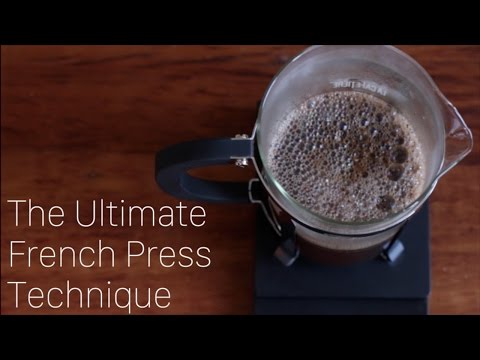
Watch: James Hoffmann’s ultimate French press technique
If you want to upgrade your French press game further, James Hoffmann’s “Ultimate French Press Technique” is the most-watched coffee video on YouTube for a reason. He shows the no-plunge skim method that produces an almost paper-filter-clean cup while keeping the body of immersion brewing. Worth eight minutes of your time.
Common French press mistakes (and how to fix them)
If your French press cup is not landing right, the fix is almost always in one of five places.
| Problem | Likely cause | Fix |
|---|---|---|
| Sludgy, gritty cup | Grind too fine | Use a coarser grind, never plunge before 4 minutes |
| Bitter, harsh finish | Over-steeped or grounds left sitting after pressing | Stick to 4 minutes, decant immediately |
| Sour, thin coffee | Under-extracted, grind too coarse or water too cool | Slightly finer grind, hotter water (just off boil) |
| Weak and watery | Too much water for the coffee dose | Move from 1:16 to 1:15 ratio |
| Lukewarm cup | Cold press or cold mug | Pre-warm the press AND the cup before brewing |
| Coffee tastes “stale” | Beans too old or pre-ground | Grind fresh, use beans within 2–4 weeks of roast date |
If you only fix one thing, fix the grind. Most French press disappointments are grind problems, either too fine (sludge + bitter) or too coarse (sour + weak). The water temperature, ratio, and steep time are easy to nail. The grind is what separates a $5 supermarket French press cup from a $5 specialty café cup.
What else can you do with a French press?
One of the underrated benefits of a French press is its versatility. The same kit makes at least three completely different drinks:
- Cold brew: Coarse grounds + cold water + 16 hours in the fridge. Press to filter when ready. Our cold brew guide has the full method.
- “Espresso” (not real espresso, but close): Fine grind, less water, harder press. Not a true 9-bar espresso shot, but the closest thing to it without an espresso machine. See our piece on how to make espresso with a French press.
- Loose-leaf tea: The mesh filter works perfectly for tea. Add leaves, steep, plunge, pour.
- Frothed milk: Warm milk in the press, pump the plunger up and down quickly for 30 seconds. Produces decent latte foam without a separate frother.
For one piece of gear that does all four, the French press might be the most versatile $40 spend in your kitchen.
The bottom line
French press is the most accessible serious brewing method. The gear is cheap, the technique is forgiving, and the cup is genuinely excellent, fuller-bodied than drip, easier to make than pour-over, no electricity required. Get the grind coarse, the water just off the boil, the ratio at 1:15, the steep at 4 minutes, and decant immediately. That is the whole formula.
Once you have brewed five or six cups, you will start tweaking, a slightly finer grind for darker roasts, a longer steep for bolder beans, less coffee when you want something gentler. French press rewards experimentation in a way that machines do not. And if you ever drop the glass carafe, that is what the Frieling is for.
Once you have French press dialled in, try our guide to making espresso-style coffee with a French press, or step into pour over with our pour over walkthrough, or see exactly how French press, pour over, and drip stack up in our brew method comparison. Upgrading the kit? See the best French presses we tested. We have more on coffee drinks.
Frequently Asked Questions About French Press Coffee
Use a 1:15 coffee-to-water ratio by weight, 1 gram of coffee for every 15 grams of water. A standard 34oz French press needs about 60g of coffee and 900g of water. Adjust to 1:14 for a stronger cup or 1:16 for lighter.
4 minutes total, from the moment you start pouring water in to the moment you press the plunger down. Under 4 minutes the coffee is under-extracted and sour. Over 5 minutes it starts to taste bitter. The 4-minute mark is the standard.
Coarse, about the size of coarse sea salt or breadcrumbs. Finer grinds end up in your cup because the mesh filter cannot catch them, and they over-extract during the 4-minute steep. A burr grinder produces the most even coarse grind.
Around 200°F (93°C), just-boiled water that has sat for 30 seconds. Boiling water at 212°F can scorch the grounds and turn the cup bitter. Water under 195°F will under-extract and taste sour.
Three fixes: use a coarser grind (sea salt texture, not finer), let the coffee sit for 30 seconds after plunging before pouring (so the fines settle), and pour slowly so the dregs stay in the press. If sludge is a persistent problem, consider an ESPRO P3, its double micro-filter is fine enough to almost eliminate sediment.
No, decant it immediately. Even after plunging, the coffee is still in contact with the grounds, which means it keeps extracting. Within 10 minutes the cup will taste bitter and dry. Always pour the coffee out into a separate carafe or your cups as soon as you press down.
 Austin Barker
Founder & Lead Editor
Seven years behind a bar before starting Brewing Coffees. Writes most of the equipment coverage and tests every machine on this site in an ordinary home kitchen.
Austin Barker
Founder & Lead Editor
Seven years behind a bar before starting Brewing Coffees. Writes most of the equipment coverage and tests every machine on this site in an ordinary home kitchen.