

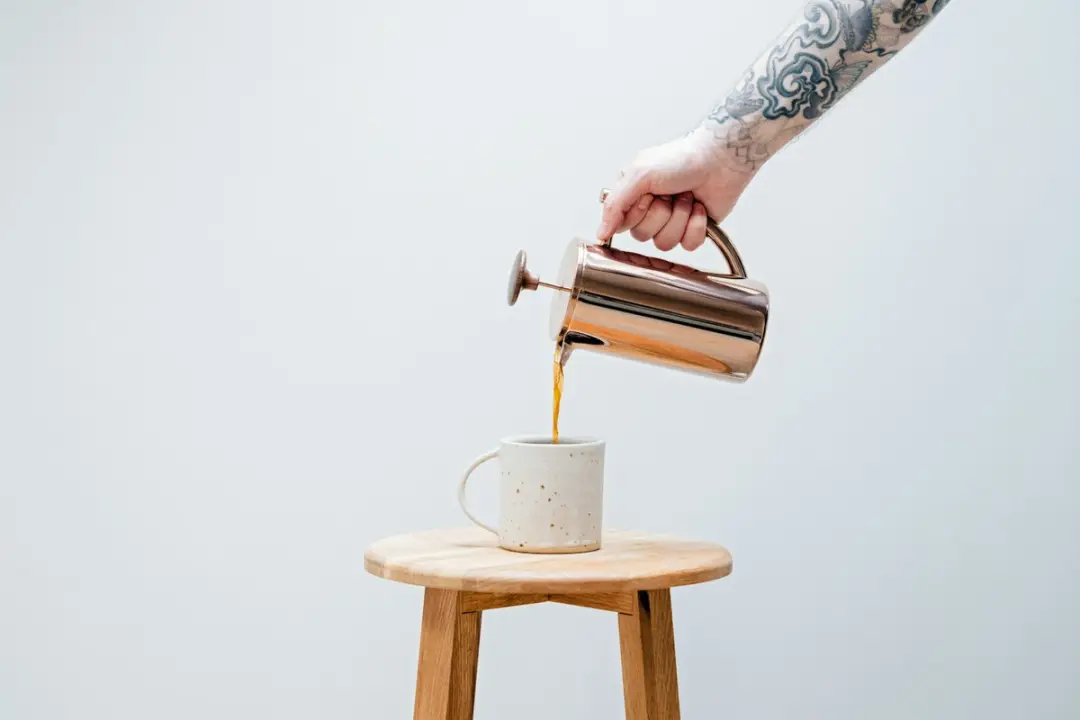
You do not need any brewing equipment to make good coffee. You need ground coffee, hot water, and something to separate the two. Every method below is a different answer to that last part, and all of them produce a better cup than a stale pod.
The ratio matters more than the method. Aim for about 1:16 by weight, which is roughly two tablespoons of grounds for a 240ml mug. Our coffee to water ratio guide has the numbers if you want to be precise. For the full comparison of methods, see how to make coffee.
The short answer
- Best cup: saucepan brew, then strain.
- Least effort: grounds straight in the mug, let them settle.
- Cleanest: a paper filter held over the mug by hand.
- Camping: cowboy coffee, settled with a splash of cold water.
- Coarser grind helps every method here, because none of them filter finely.
Method 1: the saucepan
The best of these methods, and effectively immersion brewing. Bring 500ml of water to the boil, take it off the heat for thirty seconds, then stir in 30g of medium-coarse grounds. Leave it four minutes, then pour slowly through a fine sieve into your mug. If you do not have a sieve, let it settle for two more minutes and pour carefully, leaving the last centimetre behind.
Do not boil the coffee itself. Water straight off a rolling boil is around 100C, and brewing above roughly 96C extracts the bitter compounds you were trying to avoid.
Method 2: mug and spoon
The simplest version. Put two tablespoons of coarse grounds in a mug, add hot water, stir once, and wait four minutes. The grounds sink. Drink it without stirring again and stop before the last mouthful. It is a cousin of cupping, which is how professionals actually taste coffee, so it is more respectable than it sounds.
A coarse grind is essential here. Fine grounds stay suspended and you end up drinking silt.
Method 3: a paper filter, held by hand
If you have paper filters, a coffee filter or even a folded paper towel, you have a pour over. Fold it into a cone, hold it over the mug or wedge it in with a fork across the rim, add grounds and pour slowly in circles. This gives the cleanest cup of any method here because the paper catches the oils and fines.
Rinse the paper with hot water first if you can, otherwise the first mouthful tastes of cardboard. This is the same principle as proper pour over, just without the dripper.
Method 4: improvised tea bag
Put two tablespoons of grounds in the centre of a coffee filter, a clean piece of muslin or a paper towel, gather the corners and tie it with unwaxed string or dental floss. Steep it in a mug of hot water for four minutes, squeezing gently once. Genuinely useful in a hotel room, and it means no grounds at all in the cup. See everything we have on espresso drinks.
Method 5: cowboy coffee
The camping version. Add grounds directly to a pot of hot water, off the boil, and stir. After four minutes, pour a small splash of cold water down the side. The cold water makes the grounds sink faster, which is a genuine trick rather than folklore. Pour slowly and accept a little sediment.
Ratios by method
| Method | Coffee | Water | Time | Grind |
|---|---|---|---|---|
| Saucepan | 30g | 500ml | 4 min | Medium-coarse |
| Mug and spoon | 15g | 240ml | 4 min | Coarse |
| Hand-held filter | 15g | 240ml | 3 min | Medium |
| Improvised bag | 15g | 240ml | 4 min | Medium |
| Cowboy | 60g | 1 litre | 4 min | Coarse |
What if you have no grinder either?
Whole beans can be crushed in a sealed bag with a rolling pin, the flat of a heavy knife, or a pestle and mortar. Aim for gravel rather than powder and accept that it will be uneven, which means some over-extraction alongside some under. Instant coffee is a perfectly reasonable alternative in this situation.
If you are doing this regularly rather than improvising once, a hand grinder is the cheapest thing that will improve your coffee, and a French press is essentially the saucepan method with a built-in strainer.
Which method for which situation
| Situation | Method | Why |
|---|---|---|
| Hotel room | Improvised bag, or mug and spoon | A kettle is usually the only kit |
| Camping | Cowboy coffee in the pot | One vessel, no filter to carry |
| Office with no machine | Improvised bag | No mess, nothing to wash up |
| Power cut | Saucepan on gas, or cowboy | Only needs a flame |
| Your own kitchen | Saucepan, then strain | Best cup of the five |
| Making it for four people | Saucepan, scaled up | The only one that scales cleanly |
If you have whole beans and no grinder, the goal is a coarse, roughly even crush rather than powder, because every method here relies on the grounds either sinking or being strained out.
- Rolling pin, beans in a sealed bag. Press and rock rather than hammer. Rocking crushes, hammering shatters and creates fines.
- The flat of a heavy knife. Same principle, press down with your palm on the blade. Good control, slow going.
- Pestle and mortar. Grind in small batches or the top layer stays whole while the bottom turns to dust.
- Blender or food processor, pulsed. Very uneven, but workable if you pulse rather than run it. We tested this in the food processor question.
Accept that any of these will be uneven, which means some grounds over-extract while others under-extract. Brewing a little coarser and a little longer hides it better than the reverse.
Judging strength without a scale
The ratio is the thing that matters most and the thing you are least likely to be able to measure. Two tablespoons of grounds to a standard 240ml mug is close to 1:16 and is the number worth remembering.
| If you have | Use | Water |
|---|---|---|
| A tablespoon | 2 level tbsp | 1 mug (240ml) |
| A regular teaspoon | 6 tsp | 1 mug |
| Only the mug | Grounds to cover the base, 5mm deep | Fill the mug |
| A 500ml pan | 4 heaped tbsp | Fill to 500ml |
If the result is bitter, you used too much or brewed too long. If it is sour and thin, too little or too short. Those two failure modes cover almost everything, and our ratio guide has the precise numbers once you do have a scale.
Making it for more than one person
Only the saucepan method scales cleanly. Multiply the ratio, brew in one pan, and strain into cups one at a time so the grounds settle rather than being poured out with the last of the liquid. For four mugs that is roughly 60g of coffee to a litre of water, four minutes, then strain.
The mug-and-spoon method does not scale, because you cannot control settling across several mugs at once and someone always gets the gritty one. The improvised bag method scales fine but needs one bag per mug.
Cleaning up, and what not to do with the grounds
Do not pour grounds down the sink. Wet coffee grounds bind with fat in the waste pipe and are one of the most common causes of a slow kitchen drain. Tip them into the bin or the compost, then rinse the pan.
They are genuinely useful in the garden, though not as a fertiliser in the way the internet claims: they are mildly acidic, improve structure in heavy soil, and deter slugs to a limited extent. We go through what actually works in what to do with leftover coffee grounds.
The bottom line
Hot water off the boil, a coarse grind, four minutes, and something to separate the grounds. The saucepan method is the best cup and the mug method is the least work. Neither needs anything you do not already own.
Frequently Asked Questions About Making Coffee Without a Machine
Stir coarse grounds into hot water that has come off the boil, wait four minutes, then separate the two by straining through a sieve, pouring through a paper filter held over the mug, or simply letting the grounds settle and pouring carefully.
Yes. Use a coarse grind, about two tablespoons per 240ml mug, stir once and wait four minutes for the grounds to sink. Drink it without stirring again and leave the last mouthful. Fine grounds stay suspended and make the cup gritty.
You can make your own. Put grounds in a coffee filter, muslin or paper towel, tie it closed with string or dental floss, and steep it for four minutes. Commercial coffee bags also exist and work the same way.
No. Take the water off the boil for about thirty seconds first. Brewing above roughly 96C pulls out bitter compounds, and actively boiling the coffee itself makes that considerably worse.
Pour a small splash of cold water down the side of the pot after brewing. The temperature difference makes the grounds drop faster. Then pour slowly and stop before the bottom of the pot.
 Megan Cunningham
Contributor
Tests everything in an ordinary kitchen on affordable gear.
Megan Cunningham
Contributor
Tests everything in an ordinary kitchen on affordable gear.