Pour over coffee is the brewing method that taught a generation of home baristas what their beans actually taste like. Hot water poured slowly over a bed of medium-fine grounds through a paper filter, that’s the entire process. The cup that comes out is cleaner, brighter, and more nuanced than anything a drip machine or French press can produce, because you control every variable yourself.
This guide walks you through the exact ratio, grind size, water temperature, and pour pattern that produce a great cup. We’ll also cover the three pour over brewers we’d actually recommend, Hario V60, Chemex, Kalita Wave, and how to fix the most common mistakes that make pour over taste sour, bitter, or weak.
The short answer: pour over in 5 steps
Before the full method, here is the entire process:
- Rinse the paper filter with hot water to remove papery taste and pre-warm the dripper.
- Add medium-fine grounds at a 1:16 ratio (e.g. 20g coffee for 320g water).
- Bloom: pour 2x the coffee weight (40g) and wait 30 seconds.
- Pour in steady spirals from the centre outward, finishing all water by 3 minutes.
- Let it drain. Total brew time should be 3:30 to 4:00.
That is pour over. The detail that follows is about why each step matters and how to dial in the cup to taste.
What you need to make pour over coffee
Pour over is one of the cheapest paths into serious home coffee. Total setup cost can be under $50 if you already own a kettle.
The essentials
- A pour over dripper (Hario V60, Chemex, or Kalita Wave, see below)
- Paper filters that match the dripper
- A kettle, ideally with a gooseneck spout
- A digital scale (under $15 on Amazon)
- A burr grinder (single biggest variable in cup quality)
- Filtered water
- A timer (your phone is fine)
The grinder is the most important purchase by a wide margin, see our best coffee grinder guide for the picks we’d actually recommend at every price point. Pour over is unforgiving of bad grind quality.
Three pour over brewers worth the money
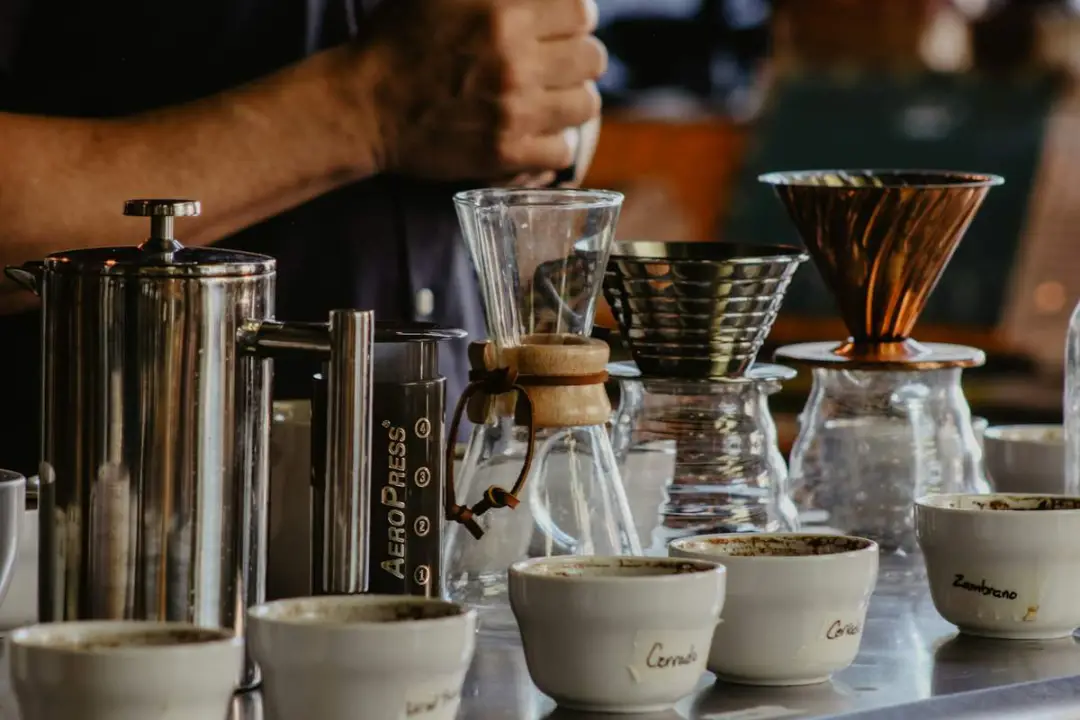
The Hario V60 02 Ceramic Dripper is the standard. Conical shape, spiral ribs inside, one big hole at the bottom. The V60 is the most demanding of the three brewers in this list, it rewards a steady pour and good technique, but it also produces the brightest, most flavour-forward cup. The ceramic version keeps temperature better than plastic. Under $25.
The Chemex Classic 6-Cup is the design icon, single piece of borosilicate glass, wooden collar, leather tie. The Chemex uses thicker filters than the V60, which produces an exceptionally clean, tea-like cup. Best for people who brew for two or want a centrepiece-style brewer. Around $50.
The Kalita Wave 185 Stainless Steel is the most forgiving option. Flat bottom (versus the V60’s cone) and three drainage holes that even out water flow regardless of your pour technique. If you have ever found V60 fussy, the Kalita Wave makes the same brew method achievable on autopilot. Stainless steel is indestructible. Around $40.
For most beginners we suggest the Kalita Wave, it produces consistent cups even when your pour is uneven. Upgrade to the V60 when you want to push for maximum flavour and you have a reliable gooseneck kettle.
Choosing your beans for pour over
Pour over rewards beans that have something to say. The paper filter strips out oils and fine sediment, leaving a clean cup where every flavour note shows up clearly. This is the brewing method where you actually taste the difference between an Ethiopian Yirgacheffe and a Colombian Supremo.
Light to medium roasts work best. Ethiopian, Kenyan, Costa Rican, Guatemalan, and other single-origins shine on pour over, the fruity, floral, citrus notes that get muted by hot French press immersion brewing come through cleanly here. Dark roasts work too, but you lose much of what makes pour over special. Save them for French press.
Freshness matters more for pour over than almost any other brewing method. Beans within 2–4 weeks of their roast date will outperform a “premium” bag that has been sitting on a shelf for 6 months. Check our guides on how long beans stay at their best and how to tell if beans are fresh if you are unsure.
The pour over coffee ratio
Use a 1:16 coffee-to-water ratio for pour over, 1 gram of coffee for every 16 grams of water. This is the SCA Golden Cup standard and the right starting point for any new pour over brewer.
| Cup size | Water (g) | Coffee (g) |
|---|---|---|
| 1 mug (240ml) | 240 | 15 |
| 1 large mug (320ml) | 320 | 20 |
| 2 cups (500ml) | 500 | 31 |
| Chemex 6-cup (700ml) | 700 | 44 |
If the cup tastes weak, move to 1:15 (more coffee per gram of water). If it tastes too strong or bitter, move to 1:17. The 1:16 starting point is intentionally middle-of-the-road. For more on dialling beans by weight, see our guide to how many coffee beans per cup.
Pour over grind size: medium-fine, like table salt
Grind your beans to a medium-fine texture, roughly the size of table salt or kosher salt. Finer than this and the water will move too slowly, over-extracting and producing a bitter, harsh cup. Coarser and water rushes through, leaving an under-extracted, sour, weak cup.
| Brew method | Grind size | Texture reference |
|---|---|---|
| Espresso | Very fine | Powdered sugar |
| Pour over (V60) | Medium-fine | Table salt |
| Pour over (Chemex) | Medium-coarse | Coarse kosher salt |
| Drip / filter machine | Medium | Table salt |
| French press | Coarse | Sea salt / breadcrumbs |
| Cold brew | Coarse | Cracked peppercorns |
The Chemex uses a slightly coarser grind than the V60 because its filters are thicker, slower drainage means the grounds need more space for water to pass through. The Kalita Wave sits between the two.
A burr grinder is essential for pour over, blade grinders produce too many fines that clog the filter and create a bitter cup. If you only have a blade grinder right now, your pour over results will plateau quickly. Upgrading the grinder is the single best improvement you can make.
Water temperature: between 195 and 205°F
Use water at 195–205°F (90–96°C). Boiling water (212°F) is too hot and extracts bitter compounds. Anything below 195°F under-extracts and tastes sour.
The simple way to hit the right temperature: bring water to a rolling boil, then take it off the heat and count 30 seconds before pouring. That drops the temperature into the sweet spot. A temperature-controlled gooseneck kettle removes the guesswork, they’re around $80 and a worthwhile upgrade if you brew daily.
Light roasts often benefit from the hotter end of the range (200–205°F) because they need more energy to extract fully. Darker roasts do better at the cooler end (195–200°F), they extract aggressively at high temperatures and turn bitter quickly.
Step-by-step: how to brew pour over coffee
This is the standard method, scaled to a single large mug. Adjust quantities for your dripper, the technique stays the same.
You will need
- 20g coffee beans (about 4 tablespoons), freshly ground medium-fine
- 320g (320ml) filtered water at 200°F
- One paper filter that matches your dripper
- Your dripper sitting on top of a mug or carafe
- Kettle, scale, timer
The method
- Boil water and start pre-heating. Bring the kettle to a boil while you grind your beans.
- Rinse the paper filter. Place the filter in the dripper, set on top of your mug. Pour hot water through the filter to soak it completely. This removes the papery taste AND pre-warms the dripper and mug. Discard the water.
- Add grounds. Tip the 20g of medium-fine grounds into the wet filter. Tap gently to level the bed flat.
- Place on the scale, tare to zero, and start your timer.
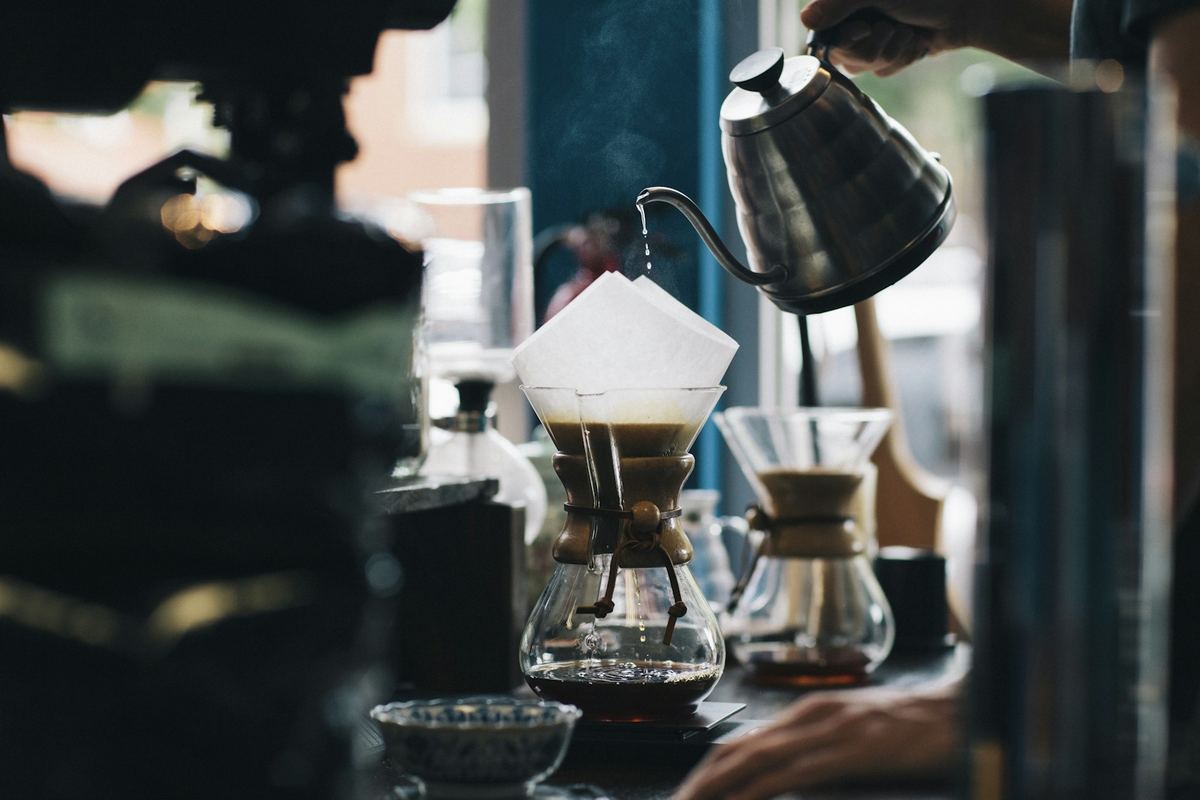
- Bloom (0:00 to 0:30). Pour about 40g of water, twice the coffee weight, directly onto the grounds, ensuring everything is wet. The bed will swell and bubble (CO2 escaping). Wait 30 seconds.
- First main pour (0:30 to 1:15). Pour slowly in a spiral from the centre outward, then back to the centre. Stop when the scale reads ~160g total water. Let it drain partially.
- Second main pour (1:15 to 2:00). Same spiral pour, this time bringing the scale to ~240g total.
- Final pour (2:00 to 2:30). Pour the remaining 80g of water to hit 320g total. Keep the spiral steady.
- Let it drain. The last water should pass through by 3:30 to 4:00 total brew time. If it’s much slower, grind coarser next time. Much faster, grind finer.
- Remove the dripper, discard the filter and grounds, and drink. The cup is best in its first 5 minutes, pour over coffee changes as it cools and the brightness fades.
That is the standard method. There are many variations (Tetsu Kasuya’s 4:6 method, Hoffmann’s 30-second pulse, single-pour techniques), once you have nailed the basics, experimenting with these is the fun part.
Total brew time: 3:30 to 4:00
A pour over should take 3:30 to 4:00 total, from the moment you start the bloom to the moment the last drops pass through. This is your most reliable diagnostic. Total time matters more than nailing each individual pour weight perfectly.
| Total time | What it means | Fix |
|---|---|---|
| Under 2:30 | Way too fast, grind too coarse or filter channelled | Grind finer, re-level the bed |
| 2:30–3:00 | Slightly fast, slightly under-extracted | Grind a touch finer |
| 3:30–4:00 | Sweet spot, balanced extraction | Drink it |
| 4:00–5:00 | Slightly slow, slight over-extraction | Grind a touch coarser |
| 5:00+ | Too slow, bitter, over-extracted | Grind much coarser, check for clogging |
If your brew time is consistently off, the grind is almost always the cause. Adjust by one or two clicks on your grinder at a time and retest with the same beans, ratio, and water temperature.
Watch: the ultimate V60 technique
James Hoffmann’s “Ultimate V60 Technique” is the most-watched pour over video on YouTube and the technique most home baristas converge on. Worth ten minutes of your time, once you have watched it, you will pour differently.

Pour over vs French press vs cold brew
If you are deciding between immersion methods (French press, cold brew) and pour over, here is the quick comparison:
| Pour over | French press | Cold brew | |
|---|---|---|---|
| Method | Percolation through paper filter | Immersion + metal mesh | Long cold immersion |
| Brew time | 3:30–4:00 | 4 min steep | 12–24 hours |
| Body | Light, clean | Heavy, full | Smooth, syrupy |
| Flavour | Bright, complex, nuanced | Rich, robust | Sweet, low-acid |
| Best beans | Light-medium single-origin | Medium-dark blends | Medium-dark chocolatey |
Pour over and French press are both excellent at different things. If you want the brightest, most flavour-forward cup that shows what a single-origin bean can do, pour over. If you want a richer, heavier cup with more body, French press, see our French press how-to. If you want a smooth, low-acid drink that keeps for a week in the fridge, cold brew.
Common pour over mistakes (and how to fix them)
| Problem | Likely cause | Fix |
|---|---|---|
| Sour, thin, acidic | Under-extracted, grind too coarse, water too cool, or pour too fast | Grind finer, raise temp, pour more slowly |
| Bitter, harsh, dry | Over-extracted, grind too fine or brew time too long | Grind coarser, aim for 3:30–4:00 total time |
| Channelling (water cuts through one spot) | Uneven bed of grounds | Tap the dripper to level, swirl gently after the bloom |
| Drains too fast (under 2:30) | Grind too coarse | Go finer by one click on your grinder |
| Stalls (water sits on the bed) | Grind too fine or too many fines from blade grinder | Go coarser, upgrade to burr grinder |
| Cup tastes papery | Skipped the filter rinse step | Always rinse the filter before brewing |
The single most common pour over mistake is grinding with a blade grinder. The next most common is skipping the filter rinse. Fix those two and 80% of pour over problems disappear.
The bottom line
Pour over is the brewing method that teaches you what coffee can actually be. The technique is simple, bloom, spiral pour, finish by 3:30–4:00, but every variable matters, which is exactly why it is so rewarding. The grinder is more important than the dripper. The beans are more important than the grinder. Get fresh beans, grind them medium-fine on a burr grinder, hit the 1:16 ratio, and you will be making better coffee than most cafés within a week.
Start with the Kalita Wave if you want the easiest learning curve. Move to the V60 when you want to chase nuance. The Chemex sits beautifully on a counter and produces an exceptional clean cup if you brew for two. There is no wrong choice, they all make better coffee than your drip machine, see exactly how much better in our French press vs pour over vs drip coffee comparison.
Pour over rewards the right kit, our best pour over makers covers V60, Chemex and Kalita Wave. Dial in dose with our coffee-to-water ratio guide, and if you ever want a denser cup, switch over to our French press method. The right beans matter as much as the method, see our best coffee beans for pour over. More on milk and espresso drinks across the site.
Frequently Asked Questions About Pour Over Coffee
Use 1:16 coffee-to-water by weight, 1 gram of coffee for every 16 grams of water. That works out to roughly 20g of coffee for a 320g (320ml) mug. Move to 1:15 for a stronger cup, 1:17 for a lighter one. Always weigh; tablespoons vary.
Medium-fine, roughly the size of table salt for a V60 or Kalita Wave, slightly coarser for a Chemex (its thicker filters need more space for water to drain). If your brew time is under 2:30, grind finer. If it’s over 4:30, grind coarser. A burr grinder is essential, blade grinders produce too many fines.
3:30 to 4:00 total brew time, from the start of the bloom to the last drip through the filter. Under 2:30 means under-extraction and a sour cup. Over 5:00 means over-extraction and bitterness. Total time is the most useful diagnostic for whether your grind and pour are dialled in correctly.
195–205°F (90–96°C). Boiling water (212°F) extracts too aggressively and turns the cup bitter. The simple method: boil the kettle, then count 30 seconds before pouring, that drops the temperature into the sweet spot. Lighter roasts do better at the hotter end, darker roasts at the cooler end.
Better-tasting, usually yes, pour over gives you full control of every variable (grind, ratio, temperature, pour rate) so the cup quality is higher. But it takes 5 minutes of active attention, where a drip machine is hands-off. Drip is more convenient for batch brewing; pour over is for when you want the best single cup.
The bloom, pouring twice the coffee’s weight in water and waiting 30 seconds before continuing, lets CO2 escape from freshly roasted beans. Skipping the bloom traps gas in the grounds, which physically blocks water from extracting properly. The result is a sour, weak, uneven cup. Always bloom, especially with beans within 4 weeks of their roast date.
 Austin Barker
Founder & Lead Editor
Seven years behind a bar before starting Brewing Coffees. Writes most of the equipment coverage and tests every machine on this site in an ordinary home kitchen.
Austin Barker
Founder & Lead Editor
Seven years behind a bar before starting Brewing Coffees. Writes most of the equipment coverage and tests every machine on this site in an ordinary home kitchen.