

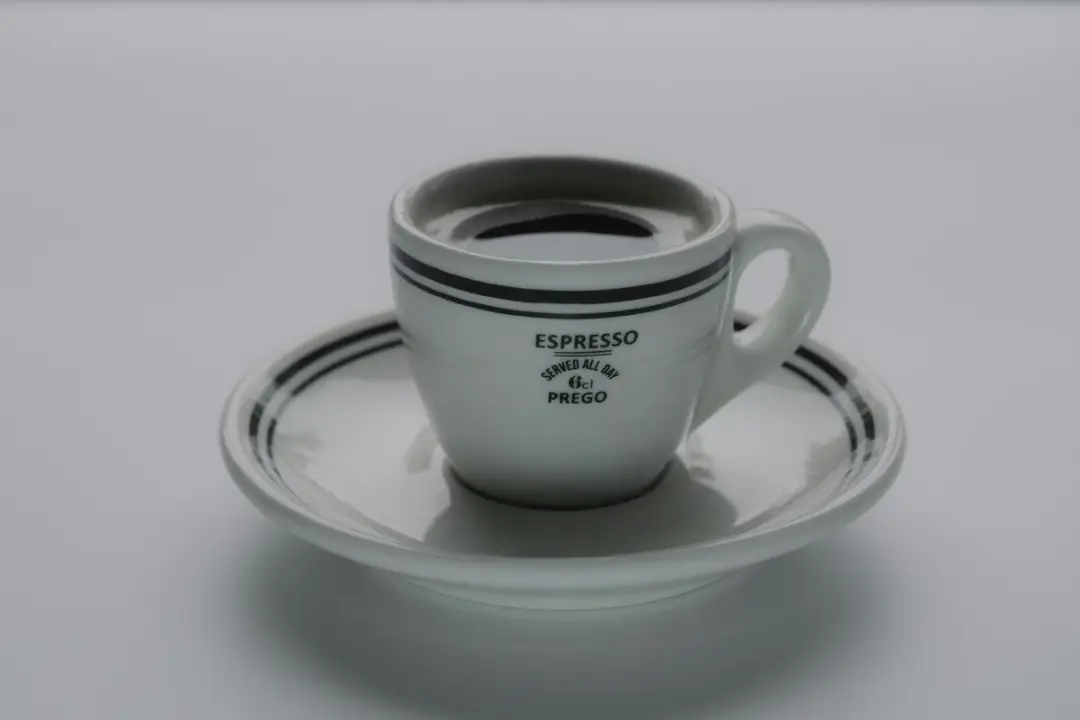
An espresso cup should hold 2 to 3oz, and that is not a stylistic preference. A double shot is about 2oz of liquid. Put it in a 6oz cup and it spreads into a thin layer with a huge surface area, which means the crema collapses and the shot goes cold in under a minute.
The traditional name is a demitasse, literally half a cup. Thick walls, small volume, and a shape that keeps the liquid deep rather than wide. Everything else is detail, but the detail is worth getting right.
What to look for in espresso cups
- 2 to 3oz for a double, 2oz for a single. Bigger is not more generous, it is colder.
- Thick walls. Thermal mass keeps the shot warm. Thin porcelain loses heat almost immediately.
- A narrow base. Keeps the liquid deep so the crema sits as a layer rather than a film.
- Double-walled glass if you want to see the shot, which is genuinely useful for judging extraction.
- Preheat whichever you buy. A cold cup will undo any of this.
At a glance
- Best overall: Epare double-walled glass, set of 4
- Best for doubles: Double-wall doppio cups, 2.7oz set of 4
- Best small set: Double-wall 3oz demitasse, set of 2
Sizes, and what each is actually for
| Size | Drink | Notes |
|---|---|---|
| 2oz (60ml) | Single espresso, ristretto | The classic demitasse |
| 2.5 to 3oz (75 to 90ml) | Double espresso, doppio | The most useful single size |
| 4 to 4.5oz (120 to 135ml) | Cortado, macchiato | Glass by convention |
| 5 to 6oz (150 to 180ml) | Flat white | Too big for espresso alone |
| 8oz and up | Latte, cappuccino | A different drink entirely |
If you buy one size, buy 3oz. It holds a double comfortably with room for the crema, and it is not so large that a single looks lost in it. For the drinks in the 4oz bracket, see what a cortado is, which explains why that one is traditionally served in glass.
Glass or ceramic?
Double-walled glass wins on one specific thing: you can see the shot. Watching the colour change as it pours, and seeing whether the crema is holding, is a real diagnostic rather than a party trick. The air gap also insulates better than most thin ceramic.
Thick ceramic wins on feel and on thermal mass if the walls are genuinely heavy. The cups you get in Italian bars are heavy porcelain for exactly that reason. What loses on both counts is thin, cheap porcelain, which looks the part and drops the temperature of a 2oz shot within seconds.
Best overall: Epare double-walled glass
A set of four 2oz double-walled glasses with handles. The insulation is genuinely effective, they are dishwasher and microwave safe, and being able to see the shot makes them the ones to own while you are still dialling in a machine. At 2oz they are sized for singles and ristrettos, so pair them with something larger if you mostly pull doubles.
Best for doubles: 2.7oz doppio cups
Wide Italian-style double-walled glasses at 2.7oz, which is the sweet spot for a double shot: enough room for the crema without letting the liquid spread thin. A set of four is the practical default for a household that drinks espresso rather than the occasional one. See everything we have on coffee gear.
Best small set: 3oz double-wall demitasse
A pair rather than a set of four, at 3oz. Worth it if you want the largest sensible espresso cup and do not need four of them, or if you are buying a second size to sit alongside 2oz glasses.
Preheat the cup, it matters more than the cup
A 2oz shot in a cold ceramic cup loses several degrees instantly, because the cup has more thermal mass than the coffee. Run hot water into the cup while the machine warms up, or sit it on the drip tray, which most machines heat passively. This is the single biggest thing separating espresso at home from espresso in a bar, and it costs nothing. Our guide to making espresso at home covers the rest of the routine.
Shape, and what it does to the crema
Volume is the first thing that matters and shape is the second, because the shape decides how deep the liquid sits and therefore how the crema behaves.
| Shape | Effect on the shot | Verdict |
|---|---|---|
| Narrow base, flared rim (tulip) | Concentrates the crema into a thick layer | The classic, and the best |
| Straight-sided cylinder | Even depth, decent crema | Fine, easy to find |
| Wide shallow bowl | Crema spreads thin and breaks up | Avoid for espresso |
| Rounded egg shape | Swirls the shot as it lands, good aroma | Good, often expensive |
The tulip shape is not decorative. A narrow base means the falling shot has less area to spread across, so the crema forms as a layer rather than a film, and it holds for longer. This is the same reason a cortado is judged in a glass: see what a cortado is for where the 4oz bracket starts.
A cold 3oz ceramic cup has more thermal mass than the 2oz of coffee going into it, so it can pull the shot down by 10C or more before you taste it. Three methods, in descending order of effectiveness:
- Fill with hot water while the machine warms up, then tip it out just before pulling. Best result, needs 30 seconds.
- Sit the cup on the drip tray. Most machines heat the tray passively. Free, slower, works if the machine has been on a while.
- Run a blank shot through it. Effective and wasteful, and it leaves the cup wet.
Skipping this undoes the benefit of any cup you buy, which is why it is worth more attention than the purchase.
Materials, durability and the dishwasher
| Material | Heat retention | Dishwasher | Notes |
|---|---|---|---|
| Thick porcelain | Excellent | Yes | The bar standard, chips at the rim |
| Double-walled glass | Very good | Usually | Shows the shot, check the seal |
| Single-wall glass | Poor | Yes | Looks good, drinks cold |
| Stoneware | Good | Yes | Heavier, often thicker walls |
| Stainless steel | Good | Yes | Can taint the taste, mostly for travel |
Double-walled glass has one failure mode worth knowing: if the seal between the walls goes, water gets into the gap and it will never dry out. Check that the manufacturer says dishwasher safe rather than assuming, and avoid thermal shock by not pouring boiling water into a cup straight from a cold cupboard.
Looking after them
- Rinse straight away. Espresso oils stain porcelain, and once the brown ring has set into the glaze it is very hard to remove.
- For existing stains, use a paste of bicarbonate of soda and water, not an abrasive scourer. Bicarb lifts the stain without scratching the glaze, and a scratched glaze stains faster next time.
- Avoid thermal shock. Do not pour boiling water into a cup that has come straight from a cold cupboard, especially double-walled glass.
- Check the dishwasher rating on glass, not just on ceramic. A compromised seal on a double-walled cup lets water into the cavity permanently.
How many you actually need
Two is enough for one person and immediately annoying for two, because espresso cups are small and you will want a clean one before the dishwasher runs. Four is the practical minimum for a household. Six if you ever make coffee for guests, since a set of six also usually costs less per cup than two sets of two.
It is also worth owning two sizes rather than four of one: a pair at 2oz for singles and ristrettos, and a pair at 3oz for doubles. The alternative is drinking every double in a cup that is slightly too small, which is how crema ends up on the saucer.
The bottom line
Buy 3oz if you buy one size, double-walled glass if you want to see what your machine is doing, thick ceramic if you want the bar feel. Avoid anything over 4oz for espresso and avoid thin porcelain entirely. Then preheat it, every time.
FAQs About Espresso Cups
2 to 3oz, or 60 to 90ml. A single shot is about 1oz of liquid and a double about 2oz, so a 3oz cup holds a double with room for the crema. Anything over 4oz lets the shot spread thin, which collapses the crema and cools it within a minute.
Demitasse is French for half a cup, and it refers to the small thick-walled cup traditionally used for espresso, usually 2 to 3oz. The thick walls are functional rather than decorative: they hold heat around a very small volume of liquid.
Double-walled glass lets you see the shot pour and judge the crema, and insulates well. Thick ceramic holds heat better if the walls are genuinely heavy, which is why Italian bars use heavy porcelain. Thin cheap porcelain is the worst of both.
Thermal mass. A double shot is only about 2oz of liquid, so it loses heat very fast. Thick walls, especially when preheated, keep the drink at temperature long enough to actually taste it.
Yes, and it makes more difference than which cup you buy. A cold cup has more thermal mass than the coffee going into it, so it pulls several degrees out of the shot immediately. Rinse with hot water or leave the cup on the drip tray.
 Joel Lewis
Contributor
Italian espresso conventions, and what survives the trip to the US.
Joel Lewis
Contributor
Italian espresso conventions, and what survives the trip to the US.