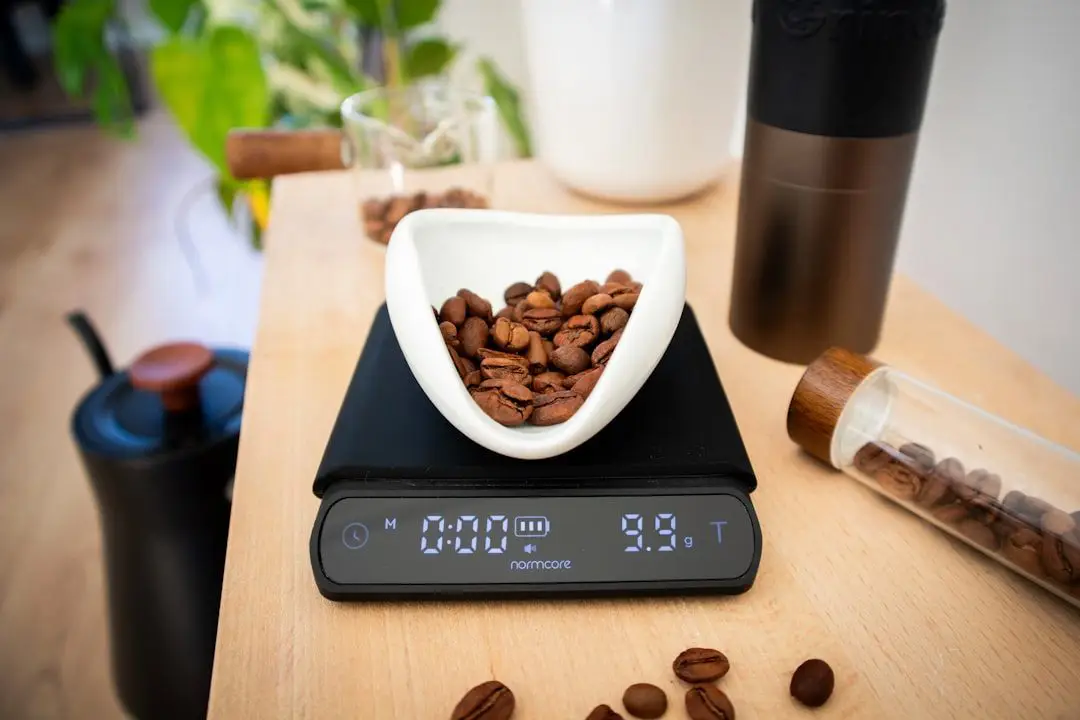
A coffee scale measures your coffee and water in grams instead of scoops, which turns a guess into a repeatable recipe. The difference is bigger than it sounds: a “heaping tablespoon” of coffee can vary by 30% or more depending on grind size and how packed the spoon is, and that swing alone can push a cup from watery to bitter with no other change.
We cover why a scale is worth owning even if nothing else about your setup changes, what to actually look for (precision, timer, tare), and four real picks across price points. For the ratios themselves once you have a scale, see our coffee to water ratio guide.
The 4 Best Coffee Scales at a Glance
- Best Overall: Acaia Pearl S
- Best Value: Timemore Black Mirror Basic Plus
- Best Budget: Timemore Black Mirror Basic
- Best for Pour Over: Hario V60 Drip Scale
Below, we break down each pick, followed by a buying guide and comparison table.
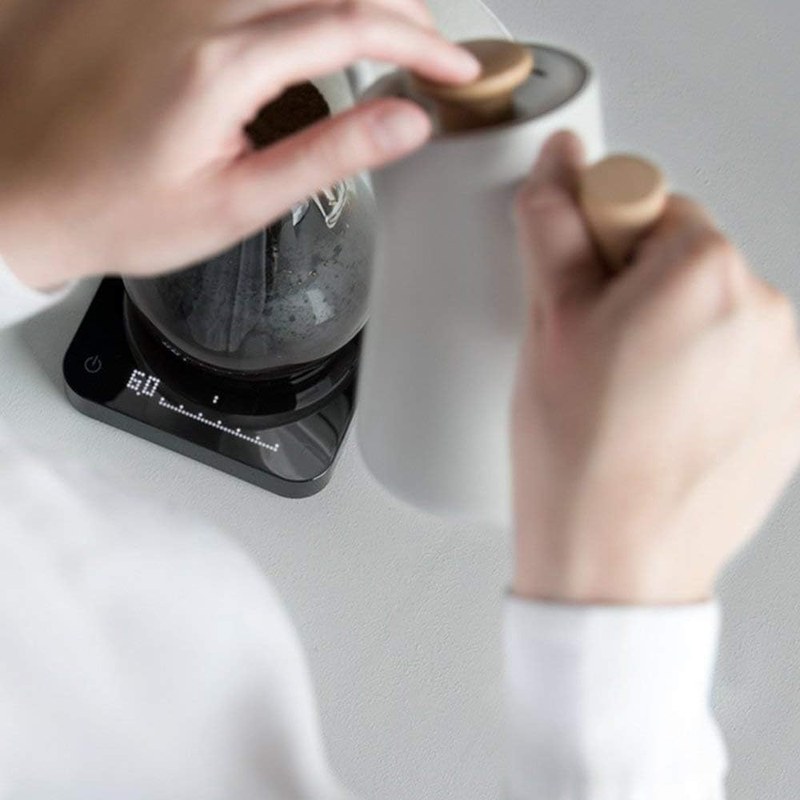
Best Overall: Acaia Pearl S
Highlights
- 0.1g resolution with 20 millisecond response time
- Built-in brew timer with Bluetooth app pairing
- USB-rechargeable battery lasting 20–30 hours
- Dual display shows weight and time at once
The Pearl S is the scale most specialty cafes and serious home brewers reach for, and the reason is response time: it registers a change in weight in about 20 milliseconds, fast enough to track a pour-over pour in real time instead of lagging half a second behind. That precision comes with a companion app that logs and graphs your pours if you want to dial in a recipe.
It is the most expensive scale in this roundup, and the price only makes sense if you actually use the timing and app features. If you just want an accurate number in grams, a cheaper option below does that job just as well.
Best Value: Timemore Black Mirror Basic Plus
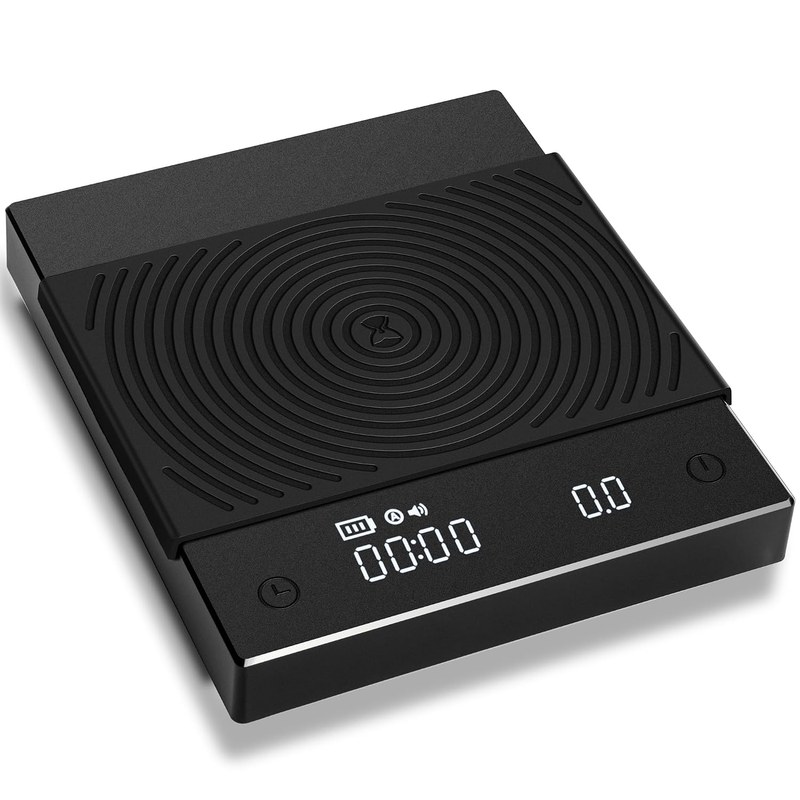
Highlights
- 0.1g accuracy up to 2000g capacity
- Built-in auto-start timer and flow-rate display
- Rechargeable battery, roughly 15 hours per charge
- Compact enough to sit under most drippers
This is the scale that shows up in more home pour-over setups than almost any other, and for good reason: it has the same 0.1g precision and built-in timer as scales twice the price, in a slim, flat design that fits under a V60 or Kalita Wave without looking bulky on the counter.
The flow-rate display is a genuinely useful extra for pour-over, it shows how fast you are pouring, not just how much you have poured, which helps with the bloom and main-pour technique described in our pour-over guide.
Best Budget: Timemore Black Mirror Basic
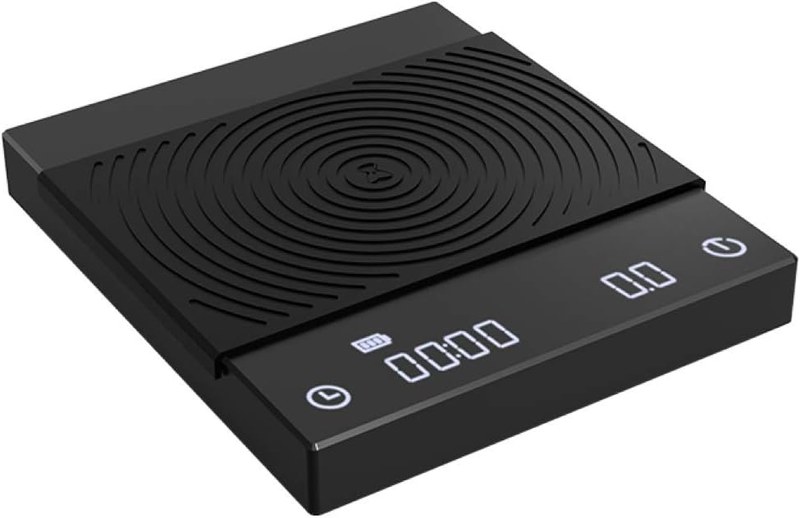
Highlights
- 0.1g accuracy, same core sensor as the Plus
- Built-in timer without the flow-rate extras
- USB Type-C rechargeable, ~15 hour battery life
- Smallest footprint in this roundup
The original Black Mirror Basic strips out the flow-rate display and app connectivity of the Plus but keeps the same accurate sensor and built-in timer, at a noticeably lower price. For anyone whose only requirement is “weigh my coffee and start a timer,” this covers it without paying for features you will not use.
It is a sensible first scale if you are not sure yet how deep into pour-over or espresso dialing-in you want to go, and an easy upgrade path later if you decide you want the flow-rate readout.
Best for Pour Over: Hario V60 Drip Scale
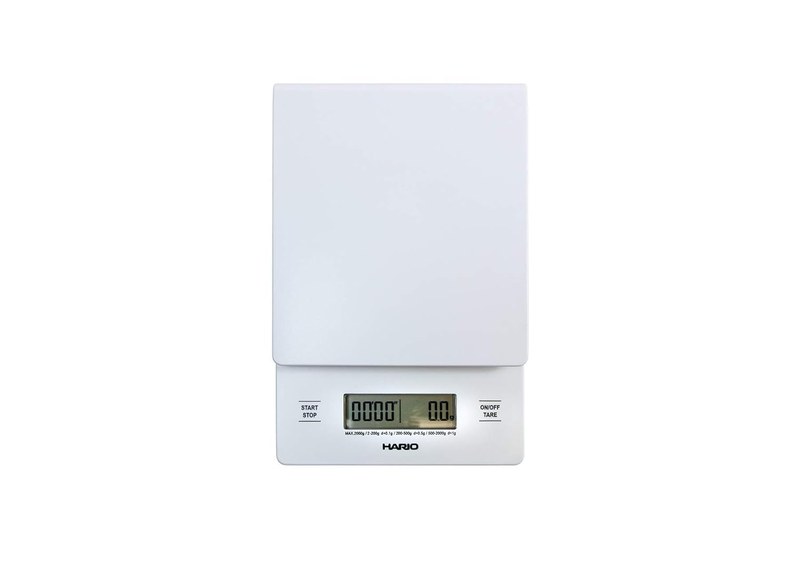
Highlights
- 0.1g precision built specifically for V60 brewing
- Built-in timer designed for pour-over pacing
- Low-profile design fits under a dripper and server
- Runs on 3 AAA batteries, no charging required
Hario builds this scale to sit under a V60 and server together, so the footprint and height are tuned for that exact setup rather than general kitchen use. If you already own a Hario V60, this is the scale designed to match it.
Running on replaceable AAA batteries instead of a rechargeable pack is a genuine advantage if you brew infrequently, no scale sitting dead from a forgotten charge cycle.
Why a Coffee Scale Matters for Consistency
Coffee-to-water ratio is written by weight for a reason: volume is not consistent. Bean density varies by roast level and origin, and how tightly grounds pack into a scoop varies by grind size, so a “tablespoon of coffee” can be anywhere from 5g to 8g depending on what you are actually measuring. Our coffee to water ratio guide covers the target ratios themselves; a scale is what actually lets you hit them.
The same logic applies to every brew method that recommends a ratio, including pour-over and French press. A cheap $10–$15 scale removes the single biggest source of cup-to-cup inconsistency in home brewing, more reliably than upgrading your beans or your brewer, see how many coffee beans per cup for what that looks like without one.
What to Look for in a Coffee Scale
0.1g Precision
Most kitchen scales round to the nearest gram or even 5 grams, which is fine for baking but not precise enough for a 20g pour-over dose, where a 1g swing is a 5% change in ratio. Look specifically for “0.1g resolution” in the listing; it is the single spec that separates a coffee scale from a general kitchen scale.
Built-In Timer
Most brew methods track total time alongside total weight, a pour-over bloom happens in a specific window, and a French press steeps for a set number of minutes. A scale with a built-in timer means one device on the counter instead of juggling a phone timer and a scale separately.
Tare Function
Tare (zeroing the scale with your dripper, mug, or French press already on it) is what makes weighing practical in the first place. Every scale in this roundup has it, but it is worth confirming on any scale not covered here, a small number of ultra-cheap kitchen scales skip it entirely.
Coffee Scales Compared
| Scale | Precision | Timer | Best For |
|---|---|---|---|
| Acaia Pearl S | 0.1g, 20ms response | Yes, app-connected | Serious home brewers, dialing in recipes |
| Timemore Basic Plus | 0.1g | Yes, with flow rate | Best all-round value |
| Timemore Basic | 0.1g | Yes, basic | Budget first scale |
| Hario V60 Drip Scale | 0.1g | Yes | Dedicated V60 pour-over setups |
Pair a scale with a good pour: our pour-over guide and French press guide both use weight-based recipes throughout. If you brew pour-over specifically, a gooseneck kettle is the other upgrade that pairs naturally with a scale, precise weight and a controlled pour solve two different halves of the same consistency problem.
There is more to read on coffee gear.
Coffee Scale FAQ
You can make coffee without one, but a scale is the most reliable way to repeat a good cup instead of guessing. Volume measurements like scoops or tablespoons vary too much between beans and grind sizes to be consistent.
Look for 0.1g resolution. A scale that only reads to the nearest gram is fine for baking but not precise enough to catch small dosing changes that noticeably affect coffee strength.
It is not required, but it is convenient, most brew methods track weight and time together, so a combined scale-and-timer means one less device on the counter.
Yes, as long as it reads to 0.1g. A dedicated coffee scale mainly adds a faster response time, a built-in timer, and a low profile that fits under a dripper.
A capable scale starts around $15–$20. Spending more buys faster response time, app connectivity, and flow-rate tracking, which matter more for pour-over dialing-in than for everyday brewing.
Yes, espresso is typically dosed and measured by weight in and weight out (for example 18g in, 36g out), so a precise scale is just as useful at the espresso machine as it is for pour-over or French press.
 Megan Cunningham
Contributor
Tests everything in an ordinary kitchen on affordable gear.
Megan Cunningham
Contributor
Tests everything in an ordinary kitchen on affordable gear.