

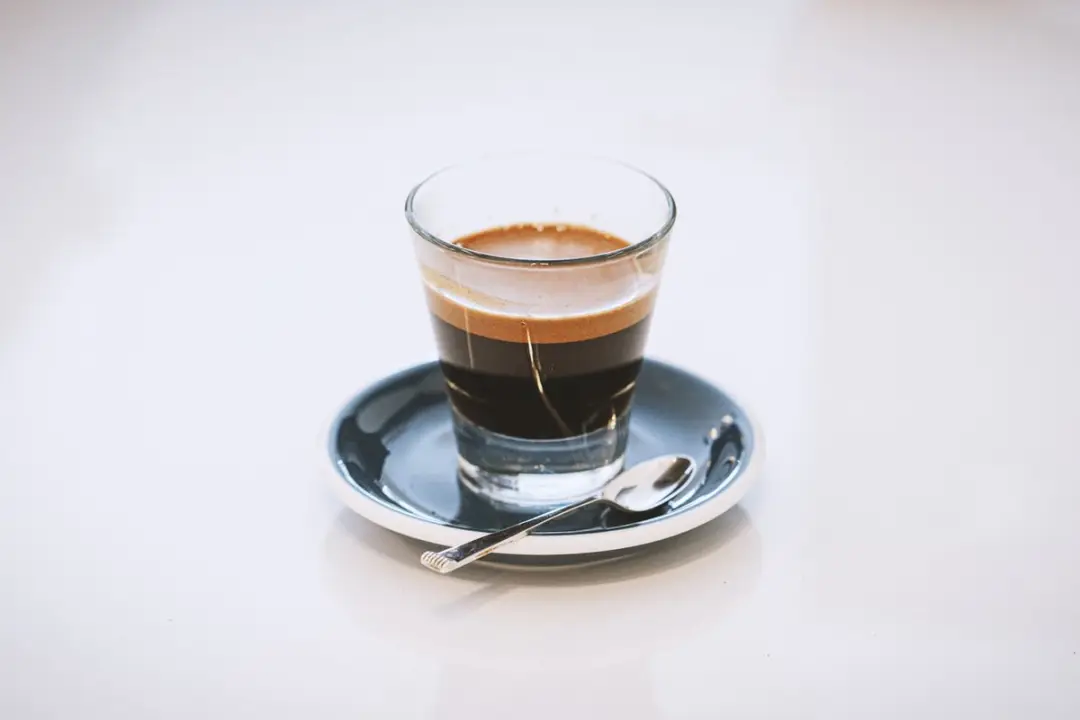
A cortado is a double shot of espresso cut with roughly the same volume of warm, barely textured milk, served in a small glass. The name comes from the Spanish cortar, to cut. The milk is there to take the edge off the espresso, not to turn it into a milk drink.
That is the whole definition, and it is the ratio rather than the recipe that makes it a cortado. Roughly 1:1. Push it to 1:2 and you have something closer to a flat white, add foam and you are into cappuccino territory.
The short answer
- Espresso: a double, about 36g in the cup.
- Milk: about 60ml, steamed warm rather than foamy.
- Ratio: 1:1, or very close to it.
- Glass: 4 to 4.5oz, traditionally glass rather than ceramic.
- Foam: almost none. A thin skin, not a layer.
Why it comes in a glass
A cortado is served in glass for a practical reason rather than a stylistic one. At this ratio the drink separates visibly into a dark base and a paler top, and the glass lets you see whether the milk has been folded in properly or is just sitting on the surface. It is a quality check you can read at a glance.
The traditional vessel is a 4oz Spanish vaso, which is why cortado glasses are usually straight-sided and thick-based. A ceramic cup works fine, but it hides the thing the drink is judged on.
Cortado vs everything it gets confused with
| Drink | Espresso | Milk | Ratio | Foam |
|---|---|---|---|---|
| Cortado | 36g double | About 60ml | 1:1 | A thin skin |
| Flat white | 36g double | About 120ml | 1:3 | 2mm microfoam |
| Latte | 36g double | About 180ml | 1:5 | 5mm |
| Cappuccino | 36g double | About 90ml | 1:2 liquid | 20mm or more |
| Macchiato | 36g double | A spoonful | Splash only | A dot |
We go into each of these properly in cortado vs latte, cortado vs flat white, cortado vs cappuccino and cortado vs macchiato.
And a cortadito is not the same thing
A cortadito is the Cuban version, and the difference is sugar. The espresso is whipped with sugar as it brews to make a foam called espuma, then cut with steamed milk. Same ratio idea, considerably sweeter drink. See everything we have on espresso drinks.
How to make a cortado at home
- Warm the glass. A 4oz glass loses heat fast and the drink is small.
- Pull a double straight into the glass, about 36g.
- Steam 100ml of milk to 60C with only a second or two of aeration. You want warm and glossy, not foamy.
- Swirl, then pour about 60ml straight through the middle. Do not try to pour a pattern, there is not enough foam for one.
- Stop at the ratio, not the rim. Filling the glass is how a cortado turns into a small flat white.
You will steam more milk than you use, which is unavoidable at this size. A smaller jug helps: it is very hard to texture 60ml of milk in a 600ml pitcher. If you are working without a steam wand, a handheld frother is enough here, because you are not trying to build microfoam.
Iced cortado
The ratio stays 1:1 but the milk goes in cold and the ice does the rest. Two shots, 60ml of cold milk, two or three cubes in a short glass. Because there is so little milk, an iced cortado dilutes faster than an iced latte, so it is a drink to make and finish rather than sip through a morning.
Which beans suit it
With this little milk, the espresso is doing almost all the work, so the roast matters more than it would in a latte. A medium roast with some sweetness handles it best. Very light roasts can read sour at a 1:1 ratio, because there is not enough milk sugar to balance the acidity. Our espresso bean picks covers the roasts that work, and what you actually pay for in a bean explains why roast and blend matter more here than price.
Where the drink comes from, and what to call it abroad
The cortado is Spanish, and in Spain it is an everyday order rather than a speciality-coffee drink: un cortado gets you a small strong coffee with a splash of warm milk, usually in a glass, usually standing at the bar. The Basque and Latin American versions differ mainly in how hot and how sweet the milk is. For a bigger, milkier Spanish coffee, see cafe con leche.
The name causes confusion in the US, where the same drink is often on the menu as a Gibraltar. That is not a different recipe, it is a glass: Blue Bottle in San Francisco served their cortado in a Libbey Gibraltar tumbler and the name stuck to the drink. If you order a Gibraltar you will get a cortado.
| Name | Where | What you get |
|---|---|---|
| Cortado | Spain, most of Europe | Espresso cut 1:1 with warm milk |
| Gibraltar | US speciality cafes | The same drink, named after the glass |
| Cortadito | Cuba, Miami | Sugar whipped into the espresso first |
| Pingo / garoto | Portugal | Espresso with a little milk, very similar |
| Noisette | France | Espresso with a hazelnut-coloured splash of milk |
Getting it right on a home machine
Two things go wrong at home, and neither is the milk. The first is volume creep: a 4oz glass looks empty when you have pulled a 36g double into it, so people top it up and end up with a small flat white. Trust the ratio, not the glass. The second is heat loss. At this size the drink cools very fast, so warm the glass properly rather than rinsing it, and pour the moment the milk is textured.
Because there is so little milk to hide behind, an under-extracted shot is very obvious in a cortado. If it tastes sharp and thin rather than sweet, that is the espresso, not the ratio. Watery, weak coffee covers the usual causes, and our ratio guide has the numbers for dialling a shot in.
Calories, caffeine and how it compares
| Drink | Milk | Calories (whole milk) | Caffeine |
|---|---|---|---|
| Cortado | 60ml | About 40 | Around 130mg (double) |
| Flat white | 120ml | About 80 | Around 130mg |
| Latte | 180ml | About 150 | Around 130mg |
| Cappuccino | 90ml plus foam | About 90 | Around 130mg |
| Espresso | None | About 3 | Around 130mg |
The caffeine barely moves across the row, because it comes from the espresso rather than the milk. What changes is the calories and how much the coffee is diluted. That is the practical reason to order a cortado: espresso strength without drinking espresso neat. Exact figures per drink are in caffeine in a shot of espresso.
With a 1:1 ratio there is very little milk sugar to balance the espresso, so the roast does more work here than in any milk drink. A medium roast with chocolate or nut character is the safe answer, because those notes survive being cut with milk. A bright, fruity light roast can read thin and sour at this ratio, which is the single most common disappointment when people make their first cortado at home.
A blend with a small proportion of robusta is worth trying too. It gives a thicker, more persistent crema, which matters in a glass where you can see it. Our espresso bean picks covers the roasts that hold up, and beans with chocolate notes is the flavour profile that suits it best.
Ordering one, and what you might get instead
Because the cortado sits in an under-defined gap between a macchiato and a flat white, what arrives varies by cafe. Some pull a single rather than a double. Some serve it in a 6oz cup, which makes it a small flat white. If you care, ask for a double in a small glass and you will get what you are after almost everywhere.
In Spain and Portugal you will get it without asking. In the US, look for Gibraltar on the board. In Australia and New Zealand, where the flat white is the default, a cortado is often not listed at all and a piccolo latte is the nearest thing on the menu.
The bottom line
Espresso, an equal amount of warm milk, a small glass, almost no foam. If you remember the 1:1 and resist filling the glass, you have it. It is the drink to order when a latte is too much milk and an espresso is too much espresso.
Frequently Asked Questions About Cortados
A double shot of espresso cut with roughly the same volume of warm, lightly textured milk, served in a small glass of about 4oz. The name comes from the Spanish verb cortar, to cut, because the milk cuts the intensity of the espresso.
One to one, espresso to milk. A 36g double shot with about 60ml of steamed milk. Anything much beyond 1:2 stops being a cortado and becomes a flat white.
Milk volume. A cortado uses about 60ml of milk and almost no foam, a latte uses around 180ml with a 5mm foam layer. A cortado tastes primarily of espresso, a latte primarily of milk.
Traditionally a 4 to 4.5oz glass, often a straight-sided Spanish vaso. Glass rather than ceramic is the convention because it shows whether the milk has been folded in properly rather than left sitting on top.
The Cuban version. The espresso is whipped with sugar as it brews to create a foam called espuma, then cut with steamed milk. Same ratio principle, much sweeter.
Around 40 to 50 calories with whole milk, since there is only about 60ml of it. That puts it well below a latte, which lands nearer 150 with the same milk.
 Joel Lewis
Contributor
Italian espresso conventions, and what survives the trip to the US.
Joel Lewis
Contributor
Italian espresso conventions, and what survives the trip to the US.