


There are many ways to brew coffee. There are more traditional brewing styles, such as the French press and Moka pot, and modern brewing styles, such as Aeropress or Minipresso. Are these brewing styles similar? What about Moka pot and Aeropress?
Moka Pot and Aeropress are manual coffee makers requiring no electricity. They, however, differ in their brewing process, mechanism of action, portability, and heat input. They also produce coffee of different volumes.
In this article, we explore the topic of Aeropress vs. Moka Pot. We will look at what they are and compare them in several aspects.
What Is Aeropress?

Aeropress is a rather new coffee brewing system, first introduced in 2005. It is made from heat-resistant plastic and has a main tube, plunger, and a bottom section to put in filter paper.
Aeropress is popular because you can operate without electricity or an external heat source. You only need ground coffee beans and hot water to brew coffee with it. It even comes with cups to hold the coffee you brew.
There are also many variations to the Aeropress, such as the Aeropress Go. This is a smaller, even more, portable version of the original Aeropress.
What Is Moka Pot?
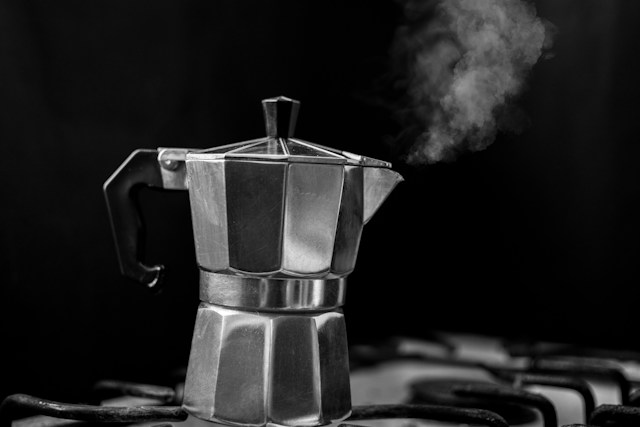
A Moka pot is also more casually called the stovetop espresso maker. First introduced in 1933, it is known to produce rich coffee with a flavor profile close to espresso. It comprises a lower chamber, a middle funnel, and an upper chamber.
Add water to the lower chamber, and place the moka pot over heat. As the water gets hot, pressure builds up and shoots the water through the middle funnel and coffee. Coffee then gets collected in the upper chamber.
Moka Pot is known to make great, concentrated coffee with great flavors. It remains one of the most popular coffee brewing methods even today.
Aeropress vs. Moka Pot
| Aspect | Moka Pot | Aeropress |
|---|---|---|
| Size | Smaller | Larger |
| Complexity | Slightly More Complex | Slightly Simpler |
| Brewing Process | Uses Percolation | Uses Immersion & Filtration |
| Heat Source | External, usually from a stove | External, usually from direct hot water |
| Consumables | Filter paper | None |
| Portability | Portable, but less operable than aeropress | Portable, more operable than moka pot |
| Coffee Volume | Usually brews less coffee | Usually can brew more coffee |
| Cleaning | Slightly more difficult to clean | Slightly easier to clean |
| AeroPress | Moka Pot | |
|---|---|---|
| Brewing method | Immersion + pressure filtration | Steam pressure percolation |
| Heat source | Pre-boiled water poured in | Stovetop (gas, electric, or induction) |
| Filter type | Paper or reusable metal mesh | Built-in metal filter |
| Brew time | 1–2 minutes | 4–5 minutes |
| Output volume | 1–3 cups (adjustable) | 1–12 cups (by model size) |
| Grind size | Fine to medium-fine | Fine (espresso-style) |
| Caffeine | Moderate–high (adjustable) | High (concentrated) |
| Best for | Travel, light/medium roasts, versatility | Home stovetop, bold/dark espresso-style |
| Price range | ~$35 | ~$30–$50 |

Size
Generally speaking, an Aeropress is usually larger than a Moka pot. This is even so when comparing both tools with similar volumes of coffee brewed.
However, there are smaller sizes of the Moka pot and AeroPress Go, so you need to ensure they have the same serving sizes when shopping.
Complexity
In general, you may assume that a moka pot is slightly more complex, as it has more parts. You have a lower and upper chamber and a middle compartment that contains a coffee portafilter and tubing.
The Aeropress should be simpler, with a main tube, bottom filter, and a plunger. Other smaller parts, such as a stirrer and a cup, are not required to make the Aeropress work.
Brewing Process
The Moka pot uses percolation to brew the coffee. Percolation is when you shoot hot water under pressure through coffee grounds. This is also used in Espresso machines and percolators.
This is different from Aeropress, which uses immersion and also filtration. Immersion happens when you brew the coffee, and filtration happens when you push the coffee through the filter paper.
Heat Source
Aeropress and Moka pots use external heat sources, meaning they cannot generate heat to brew coffee. The difference, however, and how you can provide heat to both brewing systems.
With Aeropress, you simply pour hot water into the moka pot. However, you can heat it up directly over a fire or hot plate with a Moka pot.
Consumables
Moka pot does not use any consumables, meaning there is nothing that you need to frequently buy and top up. Everything is washable and reusable.
With Aeropress, however, you must change the filter paper every time you brew a new cup. You can also use reusable steel mesh plates, but you need to purchase them separately.
Portability & Operability
Both Moka Pot and Aeropress are portable and easy to carry around. However, part of portability also includes operability. In this manner, Aeropress wins.
This is because a Moka pot requires external heat, unlike Aeropress, which only needs hot water. It is usually easier to find hot water than a stove.
Coffee Volume
In most cases, An Aeropress of similar size should be able to brew more coffee than a moka pot. This is because the Aeropress brewing unit does not have a chamber to capture brewed coffee. That job is done by an external cup.
Moka pot, however, has only a small part of it containing water to brew coffee. As a result, the volume of coffee it produces is usually smaller than an Aeropress.
Cleaning
It may be easier to clean an Aeropress than a Moka pot. This is because the Moka pot has a simpler construction, and the coffee grounds could be easily cleaned.
The Moka pot has more intricate parts, and the coffee puck in the portafilter may need a little more effort to clean than the ones in the Aeropress.
Which Makes Better Coffee? Taste Compared
Taste is where the two brewers really diverge, and the answer comes down to what kind of coffee you love.
AeroPress produces clean, smooth, and slightly acidic coffee. Because you control the steep time, water temperature, and grind size, you can dial in everything from a light, tea-like brew to a strong, concentrated shot. The paper filter removes most oils and fine particles, leaving a cleaner cup with bright, nuanced flavors. It’s particularly well-suited to light and medium roasts, where fruity and floral notes can shine through.
Moka pot produces bold, concentrated, espresso-like coffee with more body and bitterness. The steam pressure pushes water through finely ground coffee at high temperature, extracting a lot of flavor quickly. The result is thick, intense, and rich, closer to espresso than anything else you can make without an espresso machine. Dark roasts work especially well here, delivering the kind of robust, full-bodied cup that pairs beautifully with steamed milk.
If you prefer fruity, light, or single-origin coffees, the AeroPress is the better match. If you love dark, bold, espresso-style coffee, or you regularly make lattes and cappuccinos at home, the moka pot is the natural choice. Browse our coffee drink types guide to see which brewing style fits the drinks you love most.
The honest answer? Both make excellent coffee. The difference is purely about preference and what you want in the cup. There’s no wrong answer here.
Does a Moka Pot Make Real Espresso?
This is one of the most common questions about moka pot coffee, and the short answer is no, not technically.
True espresso, as defined by coffee professionals and barista standards, requires around 9 bars of pressure to force hot water through a tightly packed puck of finely ground coffee. That level of pressure is what creates the thick, syrupy shot with a signature crema on top.
A moka pot operates at roughly 1–2 bars of pressure, far below what’s needed for true espresso. There is no crema, and the extraction is slightly different. What you do get, however, is a concentrated, intensely flavored brew that is closer to espresso than any other stovetop method. Many Italian households have used moka pots for generations as their daily “espresso”, the distinction is mostly technical.
In practical terms, moka pot coffee works very well as a base for lattes, macchiatos, and cappuccinos at home. It’s rich enough to hold its own against steamed milk, and the flavor profile is similar enough that most home coffee drinkers won’t notice the difference.
The AeroPress can actually get closer to espresso-like results if you use the inverted brewing method with a fine grind and minimal water. It won’t hit 9 bars either, but the resulting concentrate is smooth, dense, and works well in milk-based drinks.
A moka pot produces around 1–2 bar of pressure. True espresso machines need 9 bar. But the resulting brew is rich, bold, and perfect for milk-based drinks.
Brewing Coffees
Which Should You Choose?
Both the AeroPress and moka pot are affordable, practical, and capable of brewing excellent coffee. The right choice depends on your habits and taste preferences. One classic use for a moka pot is Cuban coffee, a sweet, foamy shot made from the first drops.
Choose the AeroPress if:
- You travel, camp, or want a brewer that works anywhere
- You prefer light-to-medium roasts with clean, bright flavors
- You want versatility, the AeroPress can mimic pour-over, cold brew, or a concentrated shot
- You don’t mind buying filter papers (or can invest in a reusable metal filter)
Choose the Moka Pot if:
- You love bold, dark, espresso-style coffee
- You want zero consumables, no papers, no extras to buy
- You brew mostly at home on a gas or electric stovetop
- You regularly make milk-based drinks like lattes or cappuccinos
Budget: Both are very affordable. An AeroPress retails for around $35, while a quality moka pot runs $30–$50 depending on size and brand. Neither will break the bank, and both will last for years with proper care. Check out our coffee gear guides for more help choosing the right equipment for your setup.
Which Should You Buy? Our Recommendation
The right choice depends on what you value in a brewing method. If you want versatility and forgiving brewing, something you can experiment with, travel with, and clean in 30 seconds, the AeroPress is the better buy. It works with a wide range of grind sizes and water temperatures, produces very little bitterness when used correctly, and is nearly indestructible.
If you want a stovetop ritual and you enjoy a strong, bold, almost espresso-like cup that pairs well with milk or sugar, the moka pot is the better choice. It is slower to clean and requires a bit more attention on the stove, but the result is consistently rich and satisfying. The AeroPress Original (affiliate link) starts at under $35 and includes paper filters; the classic Bialetti Moka Express (affiliate link) is similarly priced and has been the definitive stovetop espresso maker since 1933.
If you are still undecided: start with the AeroPress. It has a gentler learning curve, produces a clean cup with little bitterness, and the experimentation it allows, different steeping times, temperatures, and inversion techniques, makes it genuinely fun to use. You can always add a moka pot later for variety.
Explore more in our coffee gear guides, or read about the best home cappuccino machines.
Ready to actually brew with one? Our step-by-step guides to using an AeroPress and using a moka pot walk through grind, dose and timing for each. If you are still shopping, the best pour over makers sit in a similar manual-brew bracket. There is more to read on coffee gear.
Common Questions About Aeropress vs. Moka Pot
Aeropress and Moka pots can be different in many aspects. However, the most significant areas would be coffee volume, heat course, and brewing process.
For outdoor activities such as camping, an Aeropress may be better. This is because it is easier to heat water using a kettle over a fire and then use the water to brew coffee. Getting enough concentrated heat to brew coffee using a moka pot may be hard.
Both brewing methods make equally good coffee. Both are capable of producing many types of coffee, regular or concentrated, espresso-like coffee. You may need to try both and see which style suits you better.
Both are easy to clean, but in different ways. With the AeroPress, you simply push the used puck out, rinse the chamber, and you’re done. The moka pot requires unscrewing the chambers, discarding the coffee puck, and hand washing each part. Neither should go in the dishwasher. Overall, both take under a minute to clean, the AeroPress is very slightly quicker.
Not true espresso, the AeroPress doesn’t generate the 9 bars of pressure required. However, using the inverted method with a very fine grind and less water produces a concentrated brew that works well as an espresso substitute in milk drinks like lattes and flat whites. It’s not technically espresso, but it’s close enough for home use.
The AeroPress works with a surprisingly wide range of grind sizes, which is part of its appeal. For a standard steep (2–3 minutes), use a medium grind similar to table salt, finer than filter coffee but coarser than espresso. For shorter steeping times (under 1 minute), grind finer. For longer steeps (up to 4+ minutes), grind coarser. The AeroPress is forgiving enough that even if your grind is slightly off, adjusting steep time will compensate.
Not technically, a true espresso requires 9 bars of pressure to extract, and a moka pot only generates 1–2 bars on the stovetop. However, the result is a very concentrated, bold coffee that is close enough for most practical purposes: strong enough to use in lattes and cappuccinos, and similar in flavour profile to espresso. Moka pot coffee is sometimes called ‘stovetop espresso’ in everyday language, even though it is technically a separate brewing method.
 Joel Lewis
Contributor
Italian espresso conventions, and what survives the trip to the US.
Joel Lewis
Contributor
Italian espresso conventions, and what survives the trip to the US.